Relativity
in brief... or in detail..
|
|
|
|
|
|
|
|
Relativity
in brief... or in detail.. |
Quiz: how well have you understood the Einstein Light presentation?The questions here span a range of difficulty. If you can answer them all, you have understood the material in this presentation really well - heartiest congratulations! However, if you can answer any of them, you have understood something important about relativity, so congratulations also!If you'd like to understand more, you can go back to the more detailed material on this site. And/or you can have a look at an introductory text book in physics that has one or more chapters on relativity. Question 1The chemist and the accountant. My chemistry text tells me that 12.000 g of carbon 12 is called a mole and has 6.02 x 10²³ atoms. Each atom has six protons, six neutrons and six electrons. When I look up the mass of protons, neutrons and electrons, I find that the whole is less than the sum of the parts. Carbon 12 weighs less than the combined weights of its protons, neutrons and electrons. What is the explanation?
Question 2A bus turns a corner to the right and a standing passenger, who is not holding on to the grab rail, falls over. Explain this briefly in terms of Galilean or Newtonian physics.Question 3Imagine that you are travelling in a spaceship at 99% of the speed of light. You look at your watch. Do you see anything strange? Explain your answer.Question 4If the laws of physics are the same for two observers in uniform relative motion, why do they get different answers when they calculate physical quantities? Explain briefly, perhaps with an example.Question 5When Jasper and Zoe board space ships in Energy in Newtonian mechanics and in relativity, why does Jasper's ship change colour and not Zoe's? (Hint: It is dark in deep space - like a moonless night on Earth, so the light source must be close and so must be travelling with them. A star travelling like our voyagers would show a similar colour change.)Question 6An astronaut set out in a spaceship from Earth to travel to a distant part of our galaxy. The spaceship travelled at a constant speed of 0.8 c. When the spaceship passed a certain star, the on-board clock showed the astronaut that the journey had taken 10 years. To save you punching a calculator, at the speed 0.8 c, the relativistic factor γ = (1-v2/c2)-.5 = 1.7 and its reciprocal is 0.6.An identical clock remained on Earth. What time had elapsed on the Earth clock, when the astronaut's spaceship passes the star?
(B) 6 years (C) 10 years (D) 17 years (E) none of the above (F) any of the above
Question 7A scientist measures the current flowing in two long parallel wires. The flow is in the same direction in each, as in our demonstration. Knowing the density of conduction electrons and the cross section of the wire, she works out the average speed of the electrons in the wire. Let's assume it is the same for all conduction electrons, and zero for all others. The speed v of the conduction electrons is very much smaller than c, as is usually the case. Also, let us neglect the voltage difference along the wire (the resistance of the wire is negligible).She now decides to observe the two wires from a high speed vehicle travelling parallel to the wires, in the direction of the electron travel, at the same speed. Will the force between the two wires be larger, smaller, about the same, or zero? Again, marks for the explanation of the correct answer, not just for the answer. (If the electrons move at speeds that are not << c, then this question becomes much more complicated.) Question 8A long pendulum is set swinging in a plane, somewhere on the surface of the Earth. An observer notices that the plane of the oscillation of the pendulum appears to rotate anticlockwise such that it appears to be again swinging in the same plane about 12 hours later. Is it raining?
Question 9A train moves at constant, relativistic speed. When the train passes a pole by the track, a clock on board records the time reading. There are two poles. Each has a similar clock, which records when the front of the train passes it. The clocks on the poles have been carefully synchronised.Call Ttrain the interval measured between the readings by the clock on the train, and Ttrack the interval between the readings of the pole clocks. Consider the following statements:
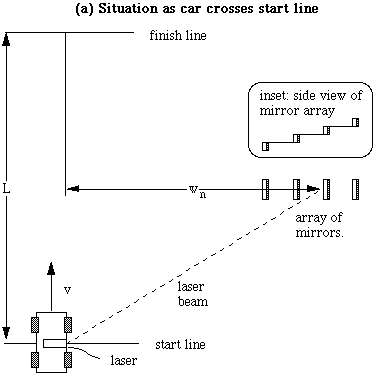
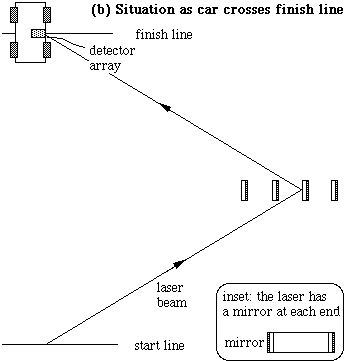
ii) According to relativity, an observer on the train sees the clocks on the poles running slow, so she predicts Ttrack < Ttrain. iii) The two observers can send each other their (already recorded) measurements, at their convenience. They cannot both be correct, so there must be a paradox. Question 10Zoe has entered her car for a new event: the Bathurst Time Trial. Her car (a '61 Holden fitted with tail fins to increase speed) is believed to be so fast that a special timing system has been devised. It works like this: at the start, a laser in the car sends a beam laterally towards an array of mirrors set up at the half-way point of the course, as shown in the two diagrams below (not to scale). The course has length L and the mirrors are at different distances wn from the track, as shown in the sketch. (The mirrors are also at slightly different heights and the beam is spread in the vertical direction so that it can hit all of them, but this detail is unimportant for the following question.)At the finish line, a reflected beam is received by one of a vertical array of detectors fixed to the side of the car. From the height of the detector that received it, one can tell which mirror reflected the beam. The further the reflector is far from the track, then the further light has travelled during the time trial, so the slower the car. The aim in this race is to have a low value of wn.
i) The judges of the race determine that the pulse received by the car at the finish line was reflected by the nth mirror, at a distance wn from the track. From this observation, the judges then calculate their value of the time tjudge taken by Zoe for the event. Derive an expression for tjudge in terms of L, wn and c, the speed of light. ii) Using your result from (i), give an expression for the speed v that the judges will record for the event. Express your answer in terms of c and the ratio wn/L. iii) Rearrange your answer to (ii) to express L/wn in terms of c and v. iii) Zoe also observes that the light has been reflected from the nth reflector. From this observation alone, and without using the Lorentz transformation equations, give an expression for the time tZoe that Zoe will calculate as the time she took to complete the distance L. Your expression should not involve v. Explain in one or two sentences how you derived your answer. iv) Zoe and the judge determine different times: tjudge does not equal tZoe. Nevertheless, from independent measurements such as the Doppler shift in light, they both agree on the speed v. Describe how Zoe (who understands relativity as well as motor mechanics) would explain the difference between the two results for tjudgeand tZoe. v) Describe how the judges (who also understand relativity) would explain the difference between the two results for tjudge and tZoe. vi) From your results above, give an expression for the ratio tjudge/tZoe. Using your expression for part iii to simplify your answer, express it in terms of the ratio (v/c) and comment briefly. vii) The laser (a gas laser) has a tube mirror at either end, with a standing light wave between the mirrors, as shown in the inset at bottom right. At what angle to the direction of the car should the laser point so that the beam will strike one of the reflectors and return to be picked up by the detector in the car at the finish line? Your answer should have a sentence or two of explanation. It should include a sketch of the situation in the frame of the judges.
Question 11 (A symmetrical 'twin paradox').Two space travellers are initially at rest, each at a large distance L from a central clock, but in opposite directions. On their twentieth birthdays, each determines that the central clock records the same time. The light has taken the same time to reach each traveller, they are both at rest in the same inertial frame so, in this frame, they are equally old. Complete symmetry.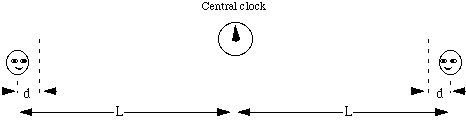
During the unaccelerated flight, they are travelling at relativistic speeds with respect to each other. Consequently, during that part of the trip, each traveller sees that other's clock is running slow, and each sees that the other is ageing more slowly. (And remember that d<
Is this a paradox that destroys relativity? If not, why not?
(As was the case with Question 9, the argument in this question was sent to me by email with the challenge that I should put it on this site, whether or not I could answer it. So I do. However, the information you need to answer these questions and so to resolve the two 'paradoxes' is already on Einstein Light.)
Do not go there straightaway, but the answers are here.
|
 |
Home
| Summary
| Quiz
|
Credits
|
|
 |
 |