Relativity
in brief... or in detail..
|
|
|
|
|
|
|
|
Relativity
in brief... or in detail.. |
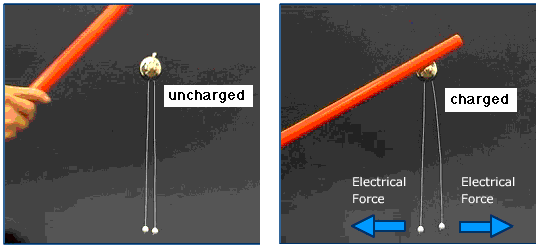
A little background in electricity and magnetismThe two films in module 2 of the presentation show essential points about electricity and magnetism respectively. We elaborate a little here. Static electricity is the name of the effect that can cause clean hair to be attracted to a comb on a dry day. When two different materials are rubbed together, one may lose some negative charge, thereby becoming positively charged. The other gains an equal negative charge. Positive and negative charges attract, and this is why your hair follows the comb. (One reason why this doesn't work well on wet days is that droplets of water can carry charge from one to another and neutralise their charge and thus the effect.) A similar effect is seen in the first film clip, whence these stills.
A rod is charged by rubbing it on a cloth. When the rod touches the metal sphere, some electric charge is transferred down the strings to the two small white balls. They therefore both have charge of the same sign as that on the rod. They immediately separate a little from each other. They no longer hang vertically downwards, because of the extra electric force acting between them. This shows that, in electricity, charges of the same type repel each other. Positive repels positive and negative repels negative. It is also true that positive attracts negative, and vice versa, but we don't show that here (if it's a dry day, try an experiment yourself). In electricity, like charges repel and opposites attract.
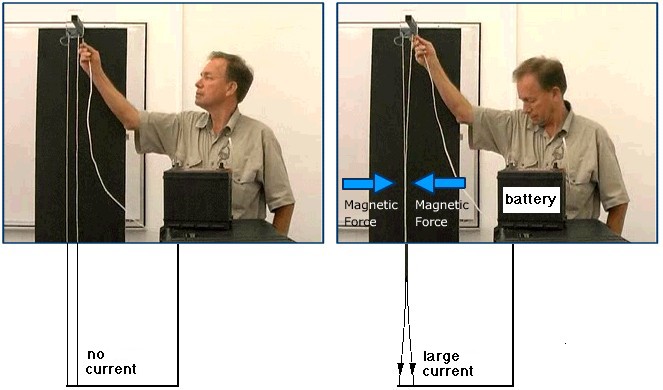
MagnetismIn the second film, two wires are initially hanging vertically and parallel (at left). A battery is suddenly connected so that current travels in the same direction in the two wires (at right). (In the film clip, it is later disconnected, and then the wires swing freely.)
Here, the magnetic forces that the wires exert on each other push the wires together. Two electric currents travelling in the same direction experience an attractive force. Electric currents are carried by moving electric charge (electrons in the case of metal wire), so if electric charges of the same sort travel in the same direction parallel to each other, the magnetic force is attractive. In magnetism, like currents attract and opposite currents repel. Safety warning. The currents involved in the second demonstration are quite large (they are produced by short circuiting a 12 volt car battery and probably exceed 100 Amperes). This demonstration is potentially dangerous: it produces sparks and, if the current flows for more than a few seconds, the wires and contacts would become very hot. The battery could also get hot. Do not do it unless you know what you're doing.
Newton's third law of motionNotice that in both the examples above, forces are produced in pairs, as promised when we discussed Newton's third law. Their directions are opposite in each case. A simple statement of Newton's third law is this: Forces come in pairs that are equal in magnitude and opposite in direction or Forces come in pairs that add to zero.
|
 |
Home
| Summary
| Quiz
|
Credits
|
|
 |
 |