|
 |
|
|
|
|
|
|
 |
A Foucault pendulum demonstrates the rotation of the earth – but the details are subtle.
The precession of a Foucault pendulum is easy enough to understand if the pendulum is suspended at one of the Earth's poles, because in this case the point of suspension is not accelerating (to a good approximation). At any other latitude, the rotation of the earth means that the point of suspension is accelerating. This introduces some more complicated time-dependent forces acting on the pendulum. At the poles, the (apparent) precession period is 23.9 hours, whereas elsewhere it is longer by a factor of the reciprocal sine of the latitude. But why? And is the precession uniform? Here we answer that. On the way, we'll derive expressions for the fictitious forces mentioned in the introduction.
This page is a physical analysis of the motion. I have kept it as simple as I could (though see footnote), but it does use vector calculus – without this tool, the analysis would be very long and awkward. (Physclips has introductory pages on vectors and calculus.) Before you start on the analysis below, however, see the simple Introduction to the Foucault pendulum.
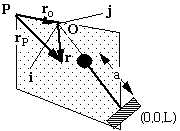
| We treat the Earth as rotating about its axis with angular velocity of magnitude Ω relative to an inertial frame. At
a point O on the Earth's surface with latitude λ, we choose a Cartesian coordinate system with the x axis
horizontal and South, the y axis horizontal and East and the z axis vertical and up. In the diagram, the i,k plane (the North-South, vertical plane at the position of our pendulum) is shaded. (Bold font is used for vectors.)
This coordinate system is not inertial: it is rotating with the Earth, so not only the position ro of its origin, but also i, j and k, are all varying in time.
P is the point on the earth's axis closest to O and ro is the vector from P to O. If the position vector of a moving particle is r relative to O, then its position vector relative to P is rp = r + ro. Further, let r be sufficiently small that the gravitational field does not vary significantly between O and r. Now P is in an inertial frame, so the equation of motion for the particle is: mr"p = mG + F (1) where m is the mass of the particle, G is the gravitational field (i.e. force per unit mass) at O, F is the sum of all forces other than gravity, and dashes signify derivatives with respect to time.
| f |
For the motion in the frame of the earth at O the acceleration is r" = r"p − r"o. Point O rotates with the angular velocity of the earth Ω, so
r"o = − Ω2 ro = − Ω2ro(sin λ i − cos λ k) (2)
so mr" = mG + F + mΩ2 ro(sin λ i − cos λ k) (3).
The last term in (3) is a fictitious force, called the centrifugal force. It's called fictitious because it doesn't exist: r"p is the acceleration in an inertial frame and, in (1), there is no centrifugal force. r" is the acceleration in a noninertial frame and, in such frames, Newton's first and second laws do not apply.
| Consider now a pendulum consisting of a particle at the end of a string length a attached to a point
with coordinates in the O frame (0,0,L). Suppose initially that the pendulum were stationary and
vertical in that frame. The tension To is the only external force and:
To = mgk (4) where g is the (local) apparent gravitational acceleration at O. (Note that g and G are neither parallel nor equal in magnitude because of the rotation of the earth. In Sydney, the centripetal acceleration due to the Earth's rotation (ac ≈ G - g) has a magnitude of 28 mm.s-2: small compared to g ≈ 9800 mm.s-2 and therefore often neglected. In the Southern hemisphere, g points North of the centre of the Earth, as shown. It's easy to picture this: the shape of the Earth is an oblate spheroid–meaning it is flattened at the poles. g is perpendicular to the surface of water.) For this vertical, stationary pendulum, substituting (4) in (3) gives |
|
mr" = mG + mgk + mΩ2 ro(sin λ i − cos λ k) (5).
This 'pendulum', remember, is not moving with respect to the earth: it's a plumb bob and it just hangs vertically. So r, r' and r" are all zero. Thus for this case, (5) gives:
G + Ω2ro(sin λ i − cos λ k) = − gk (6).
In this equation, G is the gravitational field, −gk is the apparent gravitational acceleration, and the difference is the centripetal acceleration at that latitude, r"o = Ω2ro(sin λ i − cos λ k) = − Ω2ro.
To go further, we need to look at motion in a rotating frame of reference. Let's first consider two systems having the same origin. One, with subscript i, is inertial, and the other, without subscript, is rotating with Ω. We consider a point having xiii + yiji+ ziki = xi + yj + zk. Let's differentiate with respect to time, remembering that i, j and k may all be changing:
r'i = r'+ xi' + yj' + zk'
r'i = r'+ Ω × r
which we can write as
to distinguish differentiation by observers in the inertial and rotating frames. To obtain the rate of change of a vector A in the inertial frame, we take its rate of change in the rotating frame, and add Ω × A. We can apply this operation for changes in another vector, the velocity r'. This gives
= (d/dt)rotr' + (d/dt)rot(Ω × r) + Ω × r' + Ω × (Ω × r)
= (d/dt)rotr' + Ω' × r + 2Ω × r' + Ω × (Ω × r) , which I'll write as
r"i = r" + Ω' × r + 2Ω × r' + Ω × (Ω × r) , which is a standard result for acceleration in a rotating frame.
Now the origin of our frame of reference is not only rotating, it also has centripetal acceleration, which we saw above was r"o = − Ω2ro. So, for a frame that is both rotating with Ω and turning on the Earth's surface,
We can simplify this. Even on geolotical time scales, the earth's rate of rotation is hardly changing, so the second term is zero. Provided that the length of the pendulum is much less that the radius of the earth (it is probably about a millionth), then r is so much less than ro that we may neglect the Ω × (Ω × r) term in comparison with Ω2ro, which we have seen is tens of mm.s−2. (Note that this approximation is not appropriate for very large motions, such as that of planetary winds, ocean currents or even dead reckoning in airplane flights and long range ballistics.) However, an excellent approximation in our case is that
Now consider a moving pendulum with tension T in the string. Use Newton’s second law in an inertial frame:
mr"p = T + mG (8).
Now we need to relate this acceleration r"p in the inertial frame to the r", the (apparent) acceleration in the frame on the surface of the earth. Using (6), (7) and (8), we write
mr" = T − mgk − 2m Ω × v (9).
Note the significance of the terms: the first is the string tension, the second is the apparent weight in the rotating frame and the third term, which depends on the velocity of the pendulum and on the earth's rotation is called the Coriolis force.
Resolving in coordinates fixed with respect to the earth gives:
mx" = Tx + 2mΩ sin λ y' (9.1),
my" = Ty − 2mΩ (sin λ x' + cos λ z') (9.2) and
mz" = Tz − mg + 2mΩ cos λ y' (9.3).
For z much smaller than the pendulum length a, motion in the z (vertical) direction is small and so z' and z" are approximately zero. Equation (9.3) therefore becomes:
Tz = mg − 2mΩ cos λ y' (9.3*), whose last term is very small.
For small oscillations (x, y, z all << a), the components of the tension T in the string are
Tx = − T x/a , Ty = − T y/a, Tz = T(L − z)/a (10).
As we usually do for a pendulum, set ω2 = g/a and substitute (10) and (9.3*) in (9.1) and (9.2), taking advantage of z' approx = 0 :
x" − 2Ω sin λ y' + ω2x = 0 (9.1*)
y" + 2Ω sin λ x' + ω2y = 0 (9.2*).
Now let us define the complex variable ζ = x + iy = |ζ|exp(i φ) (which represents the position of the pendulum in the horizontal plane). Multiplying (9.2*) by i and adding it to (9.1*) gives the differential equation for motion in the horizontal plane:
ζ" + 2iΩ sin λ . ζ' + ω2ζ = 0 (11).
This is a version of the equation of the harmonic oscillator, but note that the coefficient of the first derivative of ζ is purely imaginary and so it does not contribute damping.
We can verify by substitution that an approximate solution to this differential equation is:
ζ = (Aeiωt + Be−iωt)e−iΩt sin λ (12)
(But a very good approximation. Substitution of (12) into (11), differentiation and cancelling gives
i.e. the remaining term is in Ω2 which is neglible in comparison with the other terms in Ωω and ω2, which do all cancel. We note that ω for the pendulum << Ω for the Earth.)
The complex constants A and B depend on the initial conditions of position and velocity. (Two simple cases are A = +/-B, both real, corresponding to motion passing through the equilibrium point. Note, however, that if the pendulum is released from a point of maximum amplitude, it never passes exactly through ζ = 0.)
Equation (12) is readily interpreted: if the earth were not rotating (Ω = 0), the solution is just that for a simple pendulum with period = 2π/ω, whose elliptical path is given by
Finally, a complication that applies in principle to all pendulums, including those of clocks. Taking x and y components of equation (8) shows an asymmetry in the x and y directions:
x" − 2Ω sin (λ) y' + ((g/a) − Ω2 sin (λ)2) x = 0, and
y" + 2Ω sin (λ) x' + ((g/a) − Ω2) y = 0
Thus, at positions other than the poles, there is a small difference in the pendulum frequencies for the NS and EW directions. Ω/2π is of course about once per day, and for a Foucault pendulum, (g/a)1/2/2π is of order once every several seconds, so this variation is small. For a grandfather clock, (g/a)1/2/2π is faster and so the variation with orientation is smaller still. It is occasionally said that one might detect the difference in the timekeeping of a good pendulum clock when it is rotated between a NS and an EW swing. However, other effects, such as the angle of the floor, may be larger.
Thanks to Norman Phillips and Jacques Gilbert for suggestions.
Links to other sites with information on the Foucault pendulum:
I've been asked about Umberto Eco's novel "Foucault's Pendulum", which is largely concerned with a different Foucault and not much concerned with pendulums. In my opinion, the central joke of this lengthy book is indeed funny: I laughed towards the end. It is also filled with interesting scholarly references. I am not convinced it was funny enough nor sufficiently well researched to justify the tedium regularly encountered on the way.
|
© 1996. Modified 9/8/04 J.Wolfe@unsw.edu.au, phone 61-
2-9385 4954 (UT + 10, +11 Oct-Mar). School of Physics, University of New South Wales, Sydney, Australia.
|
|
|
|

 Joe's scientific home page