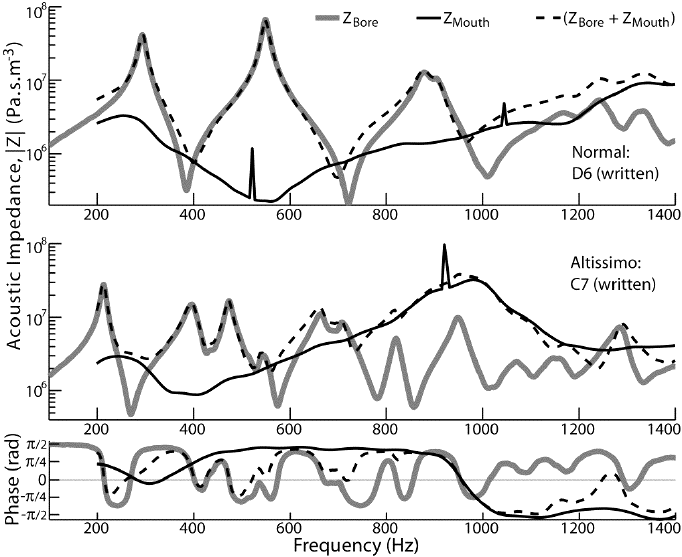
The figure at right, from the paper, shows representative acoustic impedances ZMouth (dark line) measured in the vocal tract of an expert saxophonist playing (top) the written note D6 (523 Hz, sounding C5) in the standard range and (middle) the written note C7 (932 Hz, sounding A#5) in the altissimo range of the tenor saxophone (the bottom graph shows its phase). Narrow peaks in ZMouth (dark line) indicate harmonics of the note sounded, while broad peaks indicate resonances in the mouth. The bore impedances ZBore for the two fingerings used are shown with a pale line, while the combined acoustic impedance of the player and instrument bore (ZMouth + ZBore) is shown using a dashed line. The phase is shown only for the altissimo note.
In the sound file below, a professional plays G4 and A#5 (written as A5 and C7 for the tenor saxophone).

An amateur plays G4 correctly. He then plays with the fingering for A#5. Because he does not tune the vocal tract resonance to A#5, the instrument plays at its strongest impedance peak, near 200 Hz, which is about G#3.
A professional plays comfortably over the normal range (below about F5) and altissimo range of the tenor saxophone. The two passages cover the range D#3 to A#5 (written F4 to C7) and F3 to G5 (written G4 and A6).
An amateur begins a scale at A#4 (written C6) near the top of the normal range. Above F5 (written G6), he fingers the appropriate keys. However, without appropriate vocal tract tuning, the instrument plays at one of the saxophone's strong impedance peaks that occur at lower frequency.
|