Circle of Fourths - a temperamental problem and an orchestral overture
How do you resolve the circle of fourths? There are arithmetic, pragmatic and philosophical answers. But what if you treat the circle as a suspension: how do you resolve it, musically?
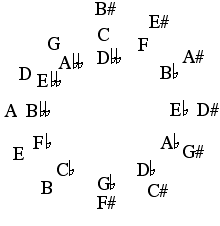
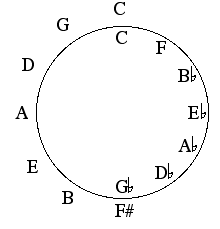
The circle of fourths as a chord, distributed across the orchestra. How would you resolve a chord that contains all the notes in the diagram at right? Where would you go from here?
Why a 'circle' of fourths? Because, as the figure below shows, 12 fourths is equal to 5 octaves ... on a keyboard, at least. This page explains the circle, and links it to human perception and the physics behind harmony. But it also introduces an orchestral overture that celebrates the circle: it uses the circle as a thematic nucleus and as a chord.
The wonder and the worry of the circle of fourths (or fifths)
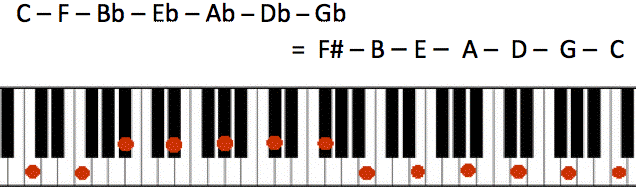
From the first note to the fourth note in a major or minor scale is a musical interval called a fourth, and a circle of fourths is shown by the red dots in the diagram above. The scale of C major starts C, D, E, F: so C to F is a fourth. F major starts F, G, A, Bb: so F to Bb is a fourth. The eighth note in a major or minor scale is called the octave, so C to C is an octave. On a piano, F sharp and G flat are the same note. So, if we ascend 12 fourths on a piano, as in the figure above, we come back home to C, whence the name circle and the diagram at top right. It's rather wonderful: on a piano, 12 fourths is exactly equal to 5 octaves
(and 12 fifths is 7 octaves).
The worry arises because a perfect fourth has a frequency ratio of 4/3 and an octave 2/1. So 5 octaves = 25 = 32, while twelve perfect fourths is (4/3)12 = 31.6. That's 1.3% difference: it's out by a quarter of a semitone – ouch – which is called the Pythagorean comma. The name tells us it's not a new problem. Minimising the potential mistuning thus caused is an arithmetically complicated process called temperament. There are many temperaments, all compromises, and all with disadvantages: lakes of ink have been poured into the problem of temperament over more than two millennia. One (rarely used) solution retains perfect fourths and fifths, so the fourths make a spiral, as shown in the figure at right, rather than a circle. This would make a keyboard complicated.
The most widely used temperament today is Equal Temperament (12 ET), which retains the pure octave, and divides it into 12 equal semitones, so that each has a frequency ratio 21/12 = 1.059. ET keeps the circle. This works pretty well for fourths and fifths, but not so well for thirds. (The problem with thirds is that 5/4 is a purer third than ET, but (5/4)3 = 125/64, which is not 2.) But why 2/1, 3/2, 4/3 and 5/4 exactly? There are some elementary details about pure intervals and temperament below, and I've written a page about temperament and Tartini tones and this more fundamental one about interference and consonance.
(You may have noticed that musical arithmetic is already a bit strange: a mathematician would expect that 12 fourths (12*4) should be 48 and that five octaves (5*8) should be 40. But no. This problem arises because musicians don't have a zero. For a musican, a single step from one note to the next in a scale is called a second, two steps is called a third and so fourth. So a second plus a second is a third, a fourth plus a fourth is a seventh... but that is a separate problem and it rarely worries musicians.)
The overture. The UNSW Orchestra commissioned the composition Circle of Fouths for its 100th concert. The brief was simple: 4 or 5 minutes of fun, using everybody and not to compete too much for rehearsal time. The orchestra is inter-faculty, so there are lots of science, engineering students playing in it. Prior to the commission we had discussed the circle, what it would sound like and how one could resolve it. So the circle would be in the new work. Further, the orchestra's archivist (cellist Eric Sowey) was keen that the piece incorporate the number 100. And one more constraint: I often use the notes 9, 8 5 (re, do, so descending) as a sort of musical signature. So these were the constraints on the process of composition. I use this as the excuse to discuss:
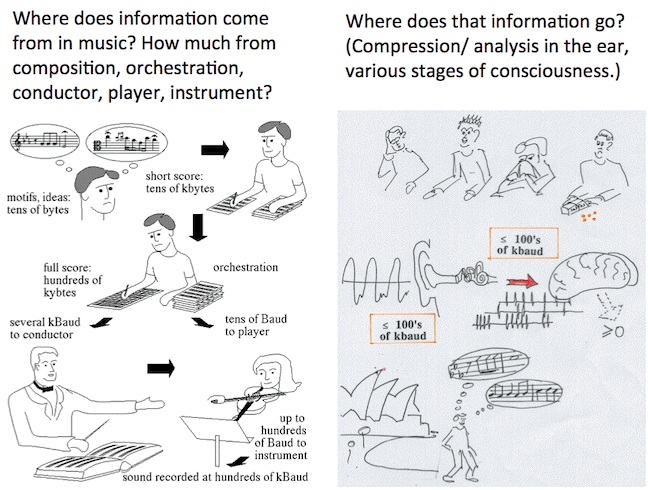
How does composing music work? Where do all the notes come from? Where does the information in a wav (or mp3) file come from? The cartoons below come from a paper I wrote on the creation and analysis of information in music, which discusses these interesting questions in some detail.
Where do tunes come from? So I thought I'd describe the origins of the themes in this piece. Different composers have different algorithms for making tunes. Some might start with a rhythm or set of pitches from the world around them: a canary call, a knock on the door etc. Others have internal algorithms, either conscious and specific or unconscious and vague. The important thing to note is that a process of generating melodies can generate many candidate tunes: the next step is to choose good ones to develop. There are further algorithms for developing a melodic nucleus into a tune, and once again one applies the process of selection. So, for those who have never composed music, there is the insight that the important step is deciding among candidates: which is worth developing? This step – deciding which of two or more is better – may be difficult to describe, but it is at least familiar to all of us. Let's see how they worked here.
I was happy that this commission already had thematic constraints: constraints limit possibilities, and limitless possibilities is too many! So remember some of the constraints. An important one was the circle of fourths, that rather strange chord that sounds like this
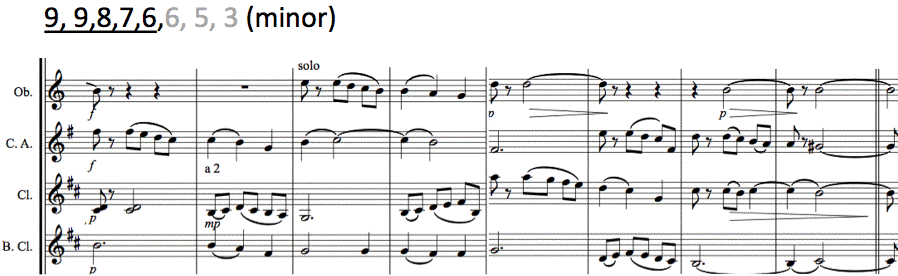
when distributed across the orchestra. I'll return to that. Then there was the requirement to include prominently the number 100. The Old Hundredth is a chorale, so named because its words are from psalm 100: 'All people that on Earth do dwell'. You can hear it here. I used it as a seed to make three themes in this piece. The Old Hundredth starts with a repeated note and then steps down a major scale: 8, 8,7,6,5. I wasn't going to steal it, but what if I used the minor scale, started a note further up and changed the rhythm from 4 to 3?
Here's how that sounds and looks (first bar in the second staff, 3rd in the top one):
Then, as you've just heard, I had to extend that. As in most tunes, repetition and repetition with variation are common and important in making an attractive melody, and especially important in making a memorable one.
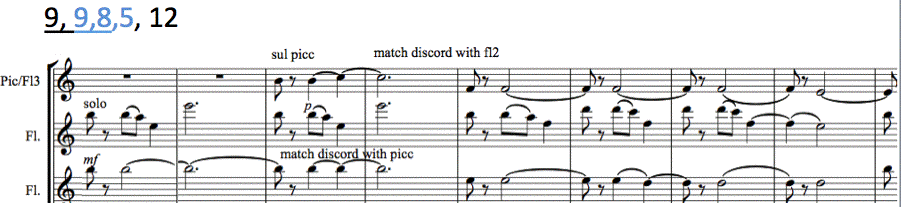
Now to the next tune. Suppose that I take the 'repeat and step down' idea, truncate it after three notes and then incorporate the 9,8,5 signature? Here's that variant:
What if I add the 100 theme to the first two fourths of a circle? Here's the tune resulting from that combination:
Now let's go back to the circle of fourths, that strange chord.
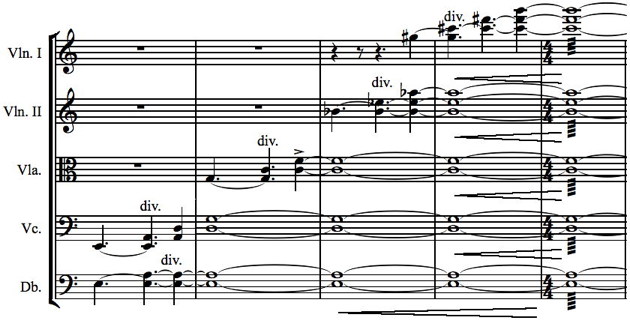
Hearing it like that, it's hard to recognise that it is a circle of fourths, but we can make that clear by building the chord up, starting at the bottom. Here's what it looks like in the strings:
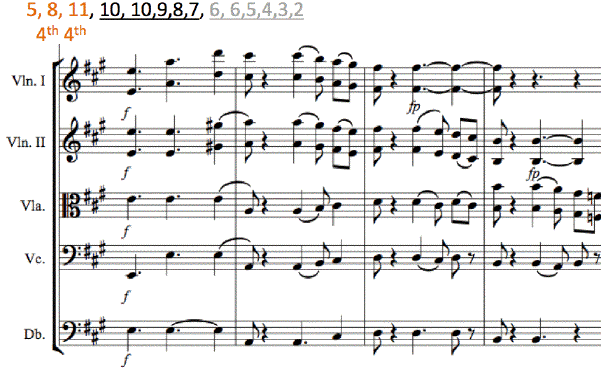
Notice that it's not quite closed: an E in the double basses and a high B in the violins. One more fourth to go, so I've given the E7 beginning the 4:4 bar to the piccolo, who specialises in high notes. You can see how the chord is distributed over the whole orchestra in bars 12, 43, 115 and 152 of the score (or 24s, 1m 14s, 3m 00s and 4m 07s in the sound file.)
About the ethics and legality of musical borrowing. While I was writing this piece, Larrikin Records surprisingly won a court action against a band that had wittily quoted
11 notes from 'Kookaburra sits in an old gum tree'. So that raises a question about the propriety of borrowing up to 5 notes from
Lloys Bourgeois, who wrote the Old Hundredth in the sixteenth century. Or, rather, from the unknown inventor of the
descending major scale, because Bourgeois, in turn, had already borrowed the phrase. Well, if Larrikin were to
buy up the old chorales for the purposes of litigation, I expect that they would by start suing Bach, who regularly used old hymn tunes in his works, such as the repeated 'O Haupt voll Blut und Wunden' in the Matthew Passion. As for the circle of fourths, it's been so much discussed over a couple of millenia that I think it's common property.
Recording, score, parts, performance etc
Here is the whole overture.
The work was first played by the University of New South Wales Orchestra on Friday, 14 May 2010. It was also played in one the Sydney Symphony Orchestra's Playerlink concerts. I don't have recordings of either of these. UNSWO played it again on 10 November 2023, which is the video above. And here is a synthetic performance or orchestral mockup made from the score by Joe Kataldo.
The score is here. The parts are available to any orchestra that would like to perform it: just write to me, or download from IMSLP.
The octave is an important interval. Consider the note A3 (the A below middle C, or the cello A string), which often has the frequency of 220 Hz – 220 vibrations per second, so each vibration takes 1/220 second. Go up an octave – eight notes in a major or minor scale – and you reach A4 (the A above middle C, or the violin A string). It has 440 vibrations per second. Play them together and the higher A has exactly two vibrations during one of the lower A. This means that, after one vibration of the lower A, the pattern repeats. This is a large part of the reason why the octave is an extremely harmonious interval. Two notes an octave apart fit together really well. ('Harmony' comes from the Greek αρμονα meaning fitting together.)
The fifth and the fourth are also important. Again using A3 as the starting note, we go up five notes from A: A, B, C#, D, E. The note E4 has 330 vibrations per second. So three vibrations of A and two vibrations of the E above take exactly the same time, and the pattern repeats exactly after that time. This gives a pure, harmonious fifth with frequency ratio 3:2. For the perfect fourth from A to D, the frequency ratio is 4:3.
 How do you resolve the circle of fourths? There are arithmetic, pragmatic and philosophical answers. But what if you treat the circle as a suspension: how do you resolve it, musically?