| |
|
|
| |
||
| |
||
| |
|
|
|
|
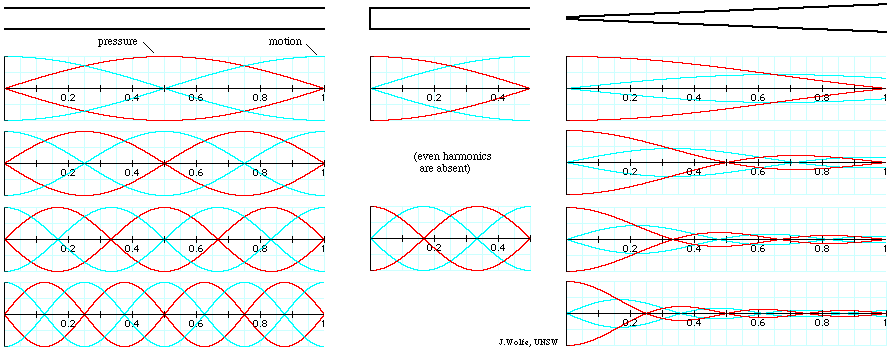
Three simple but idealised air columns: open cylinder, closed cylinder and cone. The red line represents sound pressure and the blue line represents the amplitude of the motion of the air. The pressure has a node at an open end, and an antinode at a closed end. The amplitude has a node at a closed end and an antinode at an open end. These three pipes all play the same lowest note: the longest wavelength is twice the length of the open cyclinder (eg flute), twice the length of the cone (eg oboe), but four times the open length of the closed cylinder (eg clarinet). Thus a flutist (diagram at left) or oboist (diagram at right) plays C4 using (almost) the whole length of the instrument, whereas a clarinetist (middle) can play approximately C4 (written D4) using only half the instrument. If you have a flute or oboe and a clarinet, this experiment is easy to do. Play the lowest note on the flute or oboe, and then compare this with the lowest note on half a clarinet (ie removing the lower joint and bell). Important: in all three diagrams, the frequency and wavelength are the same for the figures in each row. When you look at the diagrams for the cone, this may seem surprising, because the shapes look rather different. This distortion of the simple sinusoidal shape is due to the 1/r term, which is discussed below. (A good technical treatment is given by Ayers et al. (1985) Am. J. Phys., 53, 528 and also by Ruiz in Physics Education.) An important proviso: no instrument is a complete cone. If a conical bore came to a point, there would be no cross-section through which air could enter the instrument. So oboes, bassoons and saxophones are approximately truncated cones, with a volume in the reed or mouthpiece (plus a tiny effective volume for the reed) approximately equal to that of the truncation of the cone. For musicians who are not mathematicians, the following simplified argument is probably helpful. However, be warned that you will have to concentrate. Einstein is (incorrectly) credited with the quote "Everything should be made as simple as possible, but not simpler". I think that I have made this argument as simple as possible. But not simpler. (Mathematicians, physicists, engineers etc, may omit the following and go here.)
So the sound wave in a flute or a clarinet must be made up of sin or cos terms (which don't change in amplitude as you move along), but for saxophones, oboes and bassoons, there must be a 1/r factor to account for the cross sectional area which goes as the square of the distance from the reed. (Think of how loud the sound is at the bell, then imagine going up the bore and concentrating that sound over successively smaller areas: the sound gets louder and louder as you approach the reed.) Now we add what mathematicians call the boundary conditions (i.e. the physical constraints at the ends.) For the flute, we open the tube to the atmosphere at both ends so the pressure here is atmospheric, and the sound pressure (difference from atmospheric) is close to zero. So for the flute we want a zero in pressure at both ends, and that is met by sine waves with wavelength 2L/n where L is the length of the instrument and n is an integer (see the diagram above for the open cylinder, where this condition is met). (In practice, the end of the instrument is not quite a node, and so the effective length is longer than L by a small amount, usually about 0.6 times the radius.) For the clarinet, we want a zero at the open (bell) end, and a maximum at the reed. This is met by cosine waves with wavelength 4L/m where L is the length of the instrument and m is an ODD integer. (see the diagram above for the closed cylinder) For the conical tubes (oboe et al) we also want a zero at the bell and a maximum at the reed, but we have to fit spherical waves, which have terms involving (1/r) and (1/r2) times the sine and cos functions. For example, the standing wave in pressure has an envelope which is (1/r) times a sine wave with a wavelength which is 2L/n, where L is the length of the instrument and n is an integer. The sine goes to zero at r = L, and(1/r) sin r has a maximum at the reed, as required. Note that it has the same harmonics and the same bottom note as an open cylinder of the same length. (Some serious simplification has been made here: the oboe is only approximately a cone and the cross sectional area does not fall to zero in the reed.) Look at the graphs again. In all of the three cases (open and closed cylinders and conical), the wavelength is twice the distance between two adjacent pressure nodes. For the second, third and fourth row, you can compare these and check. With the lowest mode for the cone, there is only one pressure node so you can't see the wavelength just from looking at the graph. Why not? Why does this graph (alone) have only one pressure node? At the left hand (r=0) end of all four graphs for the cone, the sin(r) term does go to zero, but sin(r)/r goes to one, not to zero, so there is no pressure node at r=0: instead there is high pressure amplitude (which is helpful because it can drive a reed on an oboe or saxophone).
|
|
|
|
|