




Relativity
in brief... or in detail..
|
|
|
|
|
|
|
|
Relativity
in brief... or in detail.. |
Inertial frames... what is stationary? The ether (aether)?
What does 'stationary' mean?When the boat ties up and you step on the jetty, you would probably agree that the jetty is stationary. But is it? Didn't Copernicus and Galileo say that the earth moves? ("Eppur si muove" (it still moves), as Galileo is rumoured to have said after his session with the Holy Inquisition.)Wouldn't we feel it if the earth moves? (Don't tell me that the earth moved for me and I didn't notice it.) In his Dialogue Concerning the Two Chief World Systems, Galileo's characters argue this point very well. We shall be brief. Most of us will have had the experience of being in a train at a station, looking out the window and seeing another train moving. Then we see that the station is also moving... what has happened is that our train has started smoothly, i.e. with low acceleration. If the ride is sufficiently smooth and straight (if the accelerations, including those due to bumps, are very small), then we cannot readily tell, without looking outside, whether we are moving. In practice, the rails are never quite flat and so the ride is never completely smooth, but at slow speeds the effect may be very convincing. Wouldn't we feel the earth moving if it were spinning on its axis, or if it were travelling through space in an orbit around the sun st huge speed? This question was the objection of Copernicus' contemporaries and predecessors. However, in the case of motion on the train (or a bus or a plane), what is important to our sensation of motion is not the speed, but the bumps. What is important is whether or not we change our velocity, in other words we feel whether or not we are accelerating. The bus goes over a bump. Its velocity is initially horizontal but it acquires a small upwards component as it rises, then a downwards component, then back to being purely horizontal. When it accelerates up, we accelerate up too. We feel the extra force as the seat not only supports our weight, but accelerates us upwards. We feel force, so we notice acceleration. See An introduction to the mechanics of Galileo and Newton. To keep us travelling in a straight line, even at high speed, requires no nett force. And there are no bumps in space. The earth's rotation. The Earth is turning, but it takes nearly 24 hours to complete one turn on its axis: the rotation rate is 0.004 degrees per second. Now unless you are in Antarctica, you are probably thousands of kilometers from the earth's axis, so this converts into a considerable speed - over 300 m/s at the latitude of Sydney: faster than an airliner. However, the acceleration is small: again, it depends on latitude, but it is typically 2 or 3 centimetres per second per second. The force required to make you turn with the earth is less than 0.3% of your weight. This extra force is always there and hardly varying at (0.004 °/s in direction, no change in magnitude) and in any case very small (0.3% of your weight), you don't notice it. The earth's orbit. For the Earth in its orbit around the sun, the speed is 30 km/s, but the turning is even slower: 360 degrees per year. A degree per day. No wonder you don't notice it: this gives an acceleration of 6 millimetres per second per second. The required force is only 0.06% of your weight. The sun's orbit. For the Sun in its orbit around the centre of the galaxy, the speed is 220 km/s, but the acceleration only about 10 pm per second per second (a picometer, pm, is a trillionth of a metre) and the required force is 0.0000000001% of your weight. Then our galaxy and the Clouds of Magellen rotate about their centre of mass (which is 'not far' from that of our galaxy, in galactic terms) and the motion of the "local" galactic clusters. Also exceedingly small terms. Beyond that?
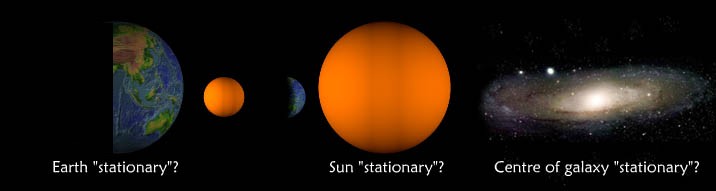 What might "stationary" mean? Animations at Einstein Light Galactic motion. Beyond that, we are at the scale for which cosmologists construct a reference frame, expanding with the universe, but in which the clusters of galaxies are not moving (much). The expansion of this frame is analysed by Einstein's other theory of relativity, the Theory of General Relativity, which is a theory of gravitation, space and time. Actually I don't know the details of how our local galatic group is moving in this frame (perhaps a cosmologist reading this will tell me), but certainly our acceleration is also extremely tiny. This story reflects humanity's gradual expulsion from the centre of the universe. We realise first that our own home or country has no special position on a nearly spherical world. Then that the world is not at the centre of the solar system. Nor, thankfully, is the sun anywhere near the centre of the galaxy. And that galaxy in turn is a pretty ordinary galaxy among billions. More recently, we find out that the dynamics of the universe are dominated not by the ordinary matter that we know, but by dark matter (which is either dark ordinary matter not yet accounted for by astronomers, or else of some new exotic sort) and by dark energy, which is also exotic. Our ordinary matter makes just several percent of the mass-energy density of the universe: it is just 'along for the ride'. Not only are we not at the centre of the universe, we are not even of the right stuff. Where do inertial frames come from?The stars appear to move in circles about a line through the poles of the earth. An ancient explanation of this (probably predating classical Greece) is that the stars are attached to a sphere which rotates about the earth. Aristachus of Samos (third century BC) explained the apparent motion of the stars and planets by proposing that the earth turns on its own axis and also travels around the sun. Hipparchus (second century BC) and Ptolemy (second century AD) rejected this view for two reasons. First, one cannot feel the rotation of the earth. Second, and more convincing, one cannot (without powerful telescopes) see annual changes in the relative position of the stars. The earth-centred view dominated European science until the seventeenth century, when Copernicus' and Galileo's began to overcome the ideas of the church.We show above that Hipparchus' and Ptolemy's arguments are based on an implicit false premise — that one would feel the motion. (These ancients didn't quantify or clearly distinguish between velocity, which we can't feel, and acceleration, which we can.) But can one demonstrate the converse, that the Earth turns? In 1851, Jean-Bernard-Leon Foucault suspended a 67 metre pendulum inside the Pantheon in Paris. The plane of its swinging was observed to rotate slowly clockwise. (See Foucault's pendulum.) It is sometimes said that the plane of the pendulum remains fixed while the Earth rotates below it. This is only true at the poles. To analyse the motion at other latitudes requires some mathematics. Once this analysis is done, it is clear that, for non-relativistic speeds, Newton's laws work in a frame in which the distant galaxies do not rotate. To the extent that Newton's laws fail to work on Earth, this failure is due to the rotation and other motion of the Earth. These effects, though small on time scales of seconds, are important on larger time scales, and are responsible for major ocean currents and wind patterns. See Coriolis forces for more detail. In Inertial frames and why the laws are the same in the train and on the platform, we introduced the idea of inertial frames — frames of reference in which Newton's laws work. Foucault's pendulum, and other much more sensitive experiments, demonstrate that an inertial frame is also one in which the distant galaxies do not appear to rotate. In the experiment described on that page, Zoe and Jasper observe a ball thrown on a merry-go-round. If it is night time, they can decide, before throwing the ball, who will see it travel in a vertical plane, and who will see it curve away sideways. They simply look up at the sky. If the stars appear to be spinning, the ball will be seen to curve. If the stars are not spinning, the ball will be seen to travel according to Newton's laws. Mach's principle and other ways out.Now, I don't know about you, but when I found out about inertial frames, I found it distinctly odd. What do the distant galaxies have to do with my throwing a ball here on Earth? And why should the universe on a large scale have no rotation? I puzzled for years over this. I remember bugging the teacher about it thus:The reason why the moon doesn't fall into the Earth is because of the moon's tangential motion. We can see it travelling across the sky, advancing roughly 14 degrees ahead of the stars each day. Now let's imagine, that we take away the sun, the other planets and all the stars, leaving only the Earth and the moon. What does it mean to say that the moon has tangential motion any more? With respect to what? Would the moon fall into the Earth? Successive teachers declined to recognise this as a serious question and it wasn't until I went to university and had easy access to a better library that I found out that the philosopher Ernst Mach had tried to answer this question, and that his solution was called Mach's principle. According to which, the Earth, the sun and all else acquire their inertia from the distant galaxies. So we have a name for it. But that doesn't help. Mach and others since have tried to quantify this. But the problem is that any effect has to be a very weak function of distance: only the very distant galaxies can have an appreciable effect, for reasons of symmetry. And what would that effect be and how would it propagate? Most importantly (as a scientific question), how could you look to see if it were there? Cosmic inflation is one possible, partial answer. Many cosmologists think that, in the extremely young universe, there was a brief period of very rapid expansion (whimsically called inflation). Because the young universe was very homogeneous (it was small enough that the various bits were close to equilibrium with each other), a rapid expansion would have given the universe much more homogeneity than would be expected from quantum mechanical fluctations and the influence of gravity, and thus explain the observed near homogeneity of the microwave background. Now angular momentum (a measurement of how much something is spinning, which we can quantify by multiplying the mass of something by the area per second it sweeps out about the centre of rotation) is conserved. If it were conserved during inflation, then any initial angular momentum of the universe would be extremely diluted afterwards: the radius of any motion would be large, so to sweep out any area would require only a very tiny angular motion. Which would explain why the universe as a whole is not spinning. But with respect to what? To explain why the frame of the distant galaxies is an inertial frame, we really need either Mach's principle or another postulate. And physicists are parsimonious with postulates.
|
 |
Home
| Summary
| Quiz
|
Credits
|
|
 |
 |